Your Manifold and Your Actuator Are One Decision, Not Two
Your Manifold and Your Actuator Are One Decision, Not Two
Most projects buy these two items in different meetings, from different people, against different drawings. The manifold gets chosen by whoever laid out the loops. The actuators get added later, usually by whoever is doing the controls package. Both choices look reasonable on their own. Together they produce the callback.
The call tends to arrive in February. One room is cold, the manifold is hot, the pump is running, and nobody can agree on which part failed.
Almost none of that is a manufacturing defect. It is a specification gap, and it sits in the space between two purchase orders.
The short answer. Size the manifold by circuit count, match the outlets to the pipe, and specify the actuator in the same order. Wrong thread, wrong NC/NO logic or insufficient closing force all produce the same symptom: a zone that runs, just not when you want it to.
Circuit count: 2 to 9 branches on the standard brass block, up to 12 in the wider family
Ratings: 16 bar, 110 °C, water
Outlets: 1″ female main; 3/4″ male Eurocone for 16×2.0 or 20×2.0 mm pipe
Actuator: 230 V AC or 24 V AC, about 2 W, ≥ 4 mm stroke, 3–5 minutes, IP54, M30 × 1.5
Failure mode: NC for most heating circuits; NO only where freezing, not overheating, is the risk
Start with a count, not a range
A manifold is sized by circuits, and a circuit count is arithmetic, not judgement. Take the heated floor area, divide by the loop length your pipe spacing allows, round up. A 110 m² ground floor at 150 mm spacing usually lands at seven or eight loops; the same area at 100 mm spacing lands higher.
The brass series covers 2 to 9 branches in the standard block, with body lengths from 110 mm to 460 mm; the wider family (M-B25, M-B32, M-BN25, M-BN32) goes to 12. Order that number, not what is in stock.
Eurocone decides whether the pipe meeting and the manifold meeting are the same meeting. PE-RT, PE-RT II and PEX all land on the same fitting — provided it was ordered for that pipe size.
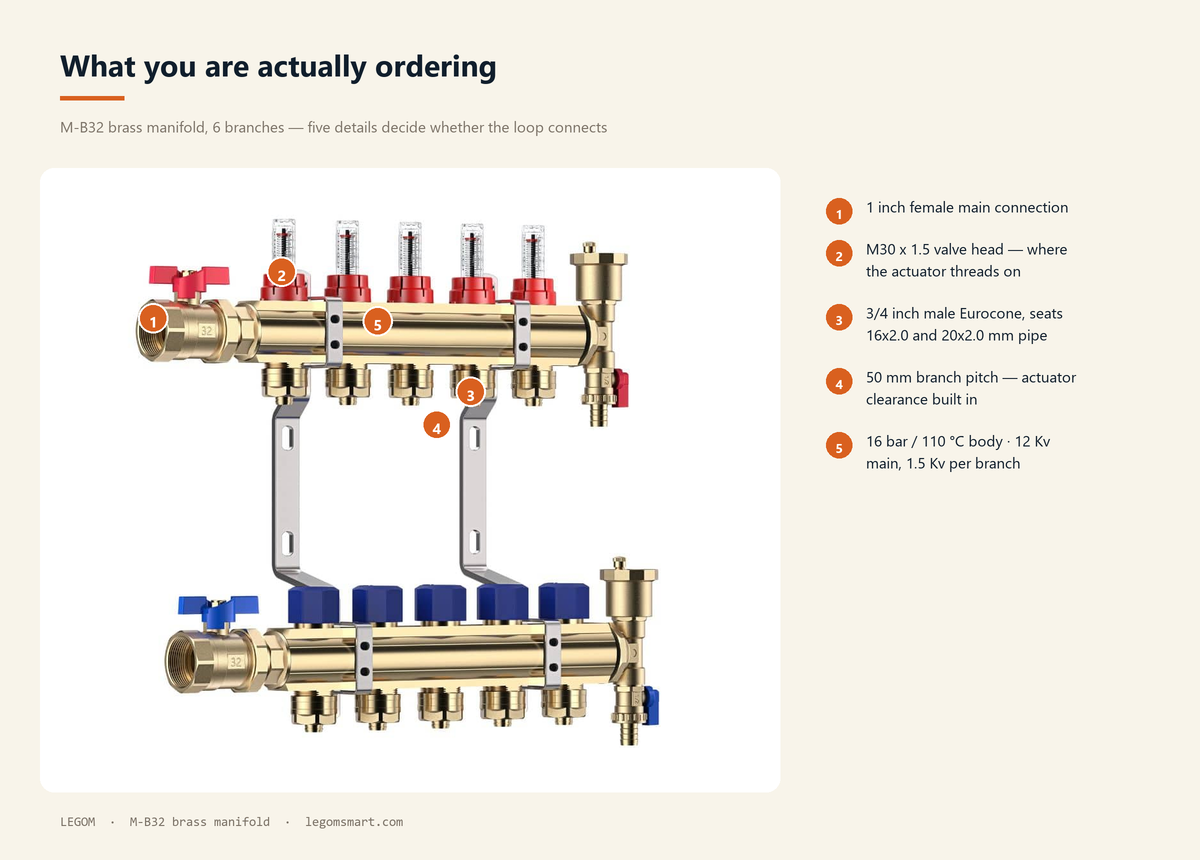
Fig. 1 — The five details on an M-B32 brass manifold that decide whether the loop connects.
The two ratings buyers check, and the one they skip
Every manifold in the range is rated 16 bar maximum working pressure and 110 °C maximum working temperature, with water as the medium. Those figures cover residential floor heating and light commercial distribution with margin to spare. They are also identical across all three material series, which means material choice is a corrosion and flow decision — not a pressure decision.
Flow is where the series actually diverge:
| Series | Body material | Main Kv | Typical use |
|---|---|---|---|
| Brass | HPb 59-1, polished and baked enamel | 12 Kv (1.5 Kv per branch) | Standard residential |
| Nickel-plated brass | Brass body, nickel layer | 12 Kv | Wet rooms, visible installations, higher corrosion exposure |
| Stainless | 304 | up to 20 Kv | Light commercial, higher flow demand |
A 12 Kv main is fine for a house. It becomes the constraint on a small commercial job with long primary runs and a heat pump pushing 45 °C water — low supply temperature means higher flow for the same heat output. Above that flow, the stainless block is not an upgrade; it is the correct part.
An actuator is not a switch
The actuator has no motor, no gear train and nothing that rotates. A sealed wax capsule sits over a PTC heating element. Power on, the wax expands, the piston extends, the valve pin is pushed down and the circuit opens. Power off, the wax cools, a return spring pulls the piston back and the circuit closes.
That mechanism sets the numbers you have to design around:
Supply: 230 V AC or 24 V AC.
Power draw: about 2 W while energised.
Stroke: ≥ 4 mm.
Travel time: 3 to 5 minutes, full stroke.
Protection: IP54.
Ambient range: −5 to 60 °C.
Thread: M30 × 1.5, the European manifold standard.
Take the travel time seriously. A thermostat that expects a zone to recover in five minutes is fighting physics. When a client complains that zoning "doesn't work", the honest answer is often that the control logic was written for a motorised valve and installed on a thermal one.
M30 × 1.5 threads onto most European manifolds without an adapter. It does not mean the actuator will close every valve: closing force still has to match the valve spring, which is why the actuator range runs to eleven models — on/off, manual override with position indicator, Wi-Fi/Zigbee, and 0–10 V modulating.
NC or NO: read the valve body, not the catalogue
Normally closed (NC) actuators hold the valve shut with no power and open it on demand. Normally open (NO) do the reverse. Both are correct. Only one is correct for your drawing.
The default for heating circuits is NC, because the failure mode you want is "this zone stops heating", not "this zone heats a room nobody is in". NO belongs where fail-safe means must not freeze — a remote outbuilding, a frost-protected plant room, a circuit protecting pipework rather than comfort.
Two questions settle it, and they should be asked before the order, not after:
With the actuator de-energised, what does the manifold valve do? Read the valve body.
If the thermostat fails, does it fail open or closed?
If those two answers disagree, the system runs backwards. It will still heat. It will just heat at the wrong times, and the fault will be blamed on the thermostat for a whole season.
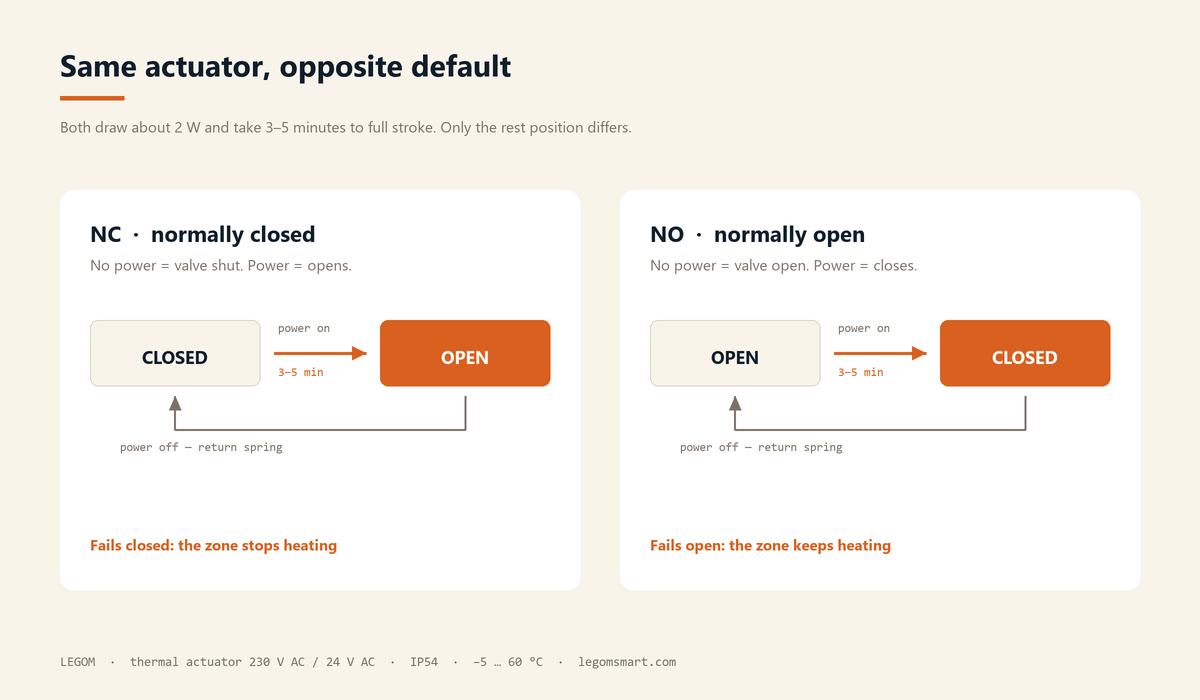
Fig. 2 — Same actuator, opposite default. The rest position is the only difference that matters at commissioning.
Quality that only shows up in year five
Two actuators look identical on a bench. The difference lives in three places.
The housing. Virgin PA66 with 30% glass fibre, not regrind. Glass fibre is what keeps the shell dimensionally stable through thousands of heat cycles; recycled material embrittles and cracks, and it usually fails the glow-wire requirement long before it visibly fails.
The seals and the spring. LEGOM tests them at 5 to 10 times the force they see in service, plus high and low temperature cycling, because a spring that sags after 20,000 cycles turns a working zone into one that never quite reaches setpoint.
The wax. Filled to 0.01 g precision, which is what makes the activation temperature repeatable unit to unit. A premium element holds better than 80% of its original performance after 100,000 cycles. A cheap one is visibly degraded by 30,000 to 50,000 — and degradation looks like a zone that opens late and never fully opens.
Ask any supplier for that cycle figure. One who has tested can quote it; one who has not will answer with the warranty.
When a zone stays cold, it is usually not the actuator
The actuator is sealed and sits outside the water, so scale cannot reach its internals. It can seize the valve pin underneath — and from above, a seized pin and a dead actuator look identical.
The test costs thirty seconds. Pull the actuator off and press the exposed pin with your thumb.
Pin moves freely and springs back: the actuator is the problem.
Pin is stiff or immovable: the valve is the problem, and a new actuator will change nothing.
Before that, two cheaper checks: confirm the zone is actually calling (setpoint well above room temperature, then wait five minutes), and measure voltage at the actuator terminals. No voltage means the fault is upstream in the thermostat or the wiring centre.
"The most common service call we see is a perfectly good actuator replaced because the valve underneath it was stuck. From above they are identical: the room is cold and nothing is moving. The thumb test takes thirty seconds. If the pin moves, you have found your actuator. If it does not, you can fit ten new actuators and the room stays cold." — Maggie Shen, Director, LEGOM
Two things that make the pair work
Balance the loops. A long loop with the same flow setting as a short one heats more slowly, and no actuator setting fixes that. Balance at the manifold, then let the actuators do zoning.
Match the manifold to the heat source. On a condensing boiler at 70/50 °C the manifold is a divider. On an R32 heat pump at 35 to 45 °C it distributes flow across the whole emitter surface, and what matters shifts from temperature to Kv and pressure drop.
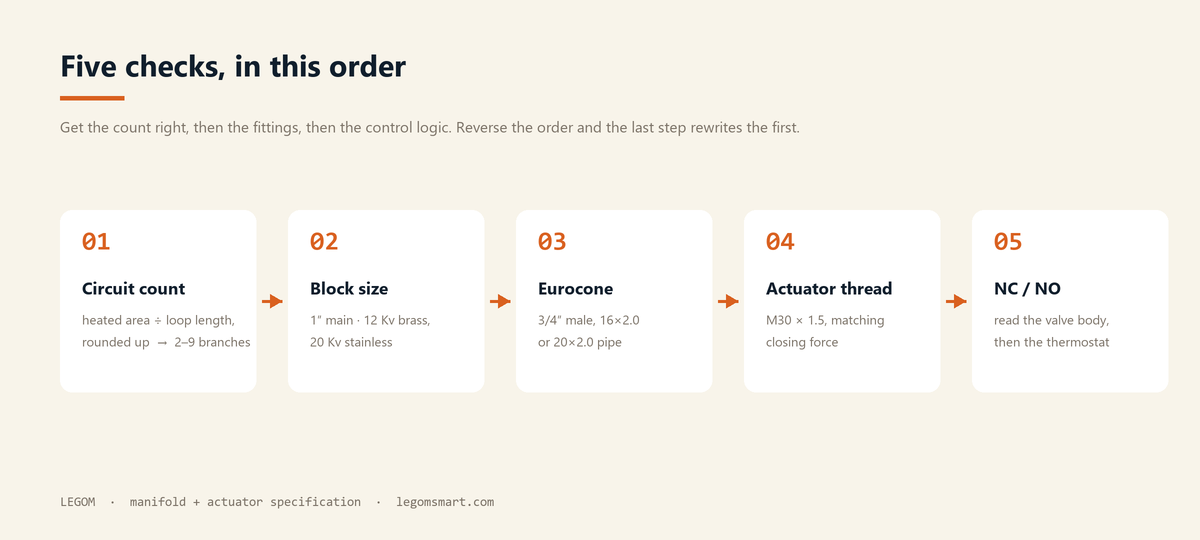
Fig. 3 — Five checks, in this order. Reverse them and the last step rewrites the first.
Commissioning checklist
Circuit count matches the loop layout, with no capped spare branches.
Eurocone size matches the pipe actually delivered to site.
Every actuator is NC or NO per the design, and consistent with its thermostat.
Each actuator is threaded to M30 × 1.5 and fully seated, not hand-tight.
Loops balanced before the control system is declared live.
One spare actuator per ten zones, on site, labelled.
That last line is not a sales suggestion: it is the difference between a one-hour service visit and a three-week parts order mid-season.
FAQ
How many branches does a floor heating manifold need? One per circuit: heated area ÷ loop length, rounded up. The brass block covers 2 to 9 branches; the family extends to 12.
Can I use any 230 V actuator on a LEGOM manifold? Mechanically, if it has an M30 × 1.5 thread. Practically, check closing force against the valve spring, then check NC/NO against the thermostats.
What is the difference between a 12 Kv and a 20 Kv manifold? Kv is how much water the block passes at a given pressure drop. 12 Kv suits residential; 20 Kv stainless suits higher-flow light commercial work, especially low-temperature heat pump systems.
Why does my new actuator hold the circuit open before commissioning? Many ship in a first-open position so the system can be filled, pressure-tested and flushed before the electrical work is complete. It is not a fault.
Does a 2 W actuator cost anything to run? Two watts per zone, only while calling. Ten zones at 50% duty is roughly 90 kWh over a heating season. The figure matters for transformer and control-box loading, not the bill.
Related reading. Wax thermostatic elements in underfloor heating and automation · Underfloor heating manifold range · Thermal actuator range